By Leo Donkersley. September 8, 2026.
Why choosing gear carefully — and keeping it in use — can be a better way forward.
There is something satisfying about gear that you use a lot. Gear that stays with you.
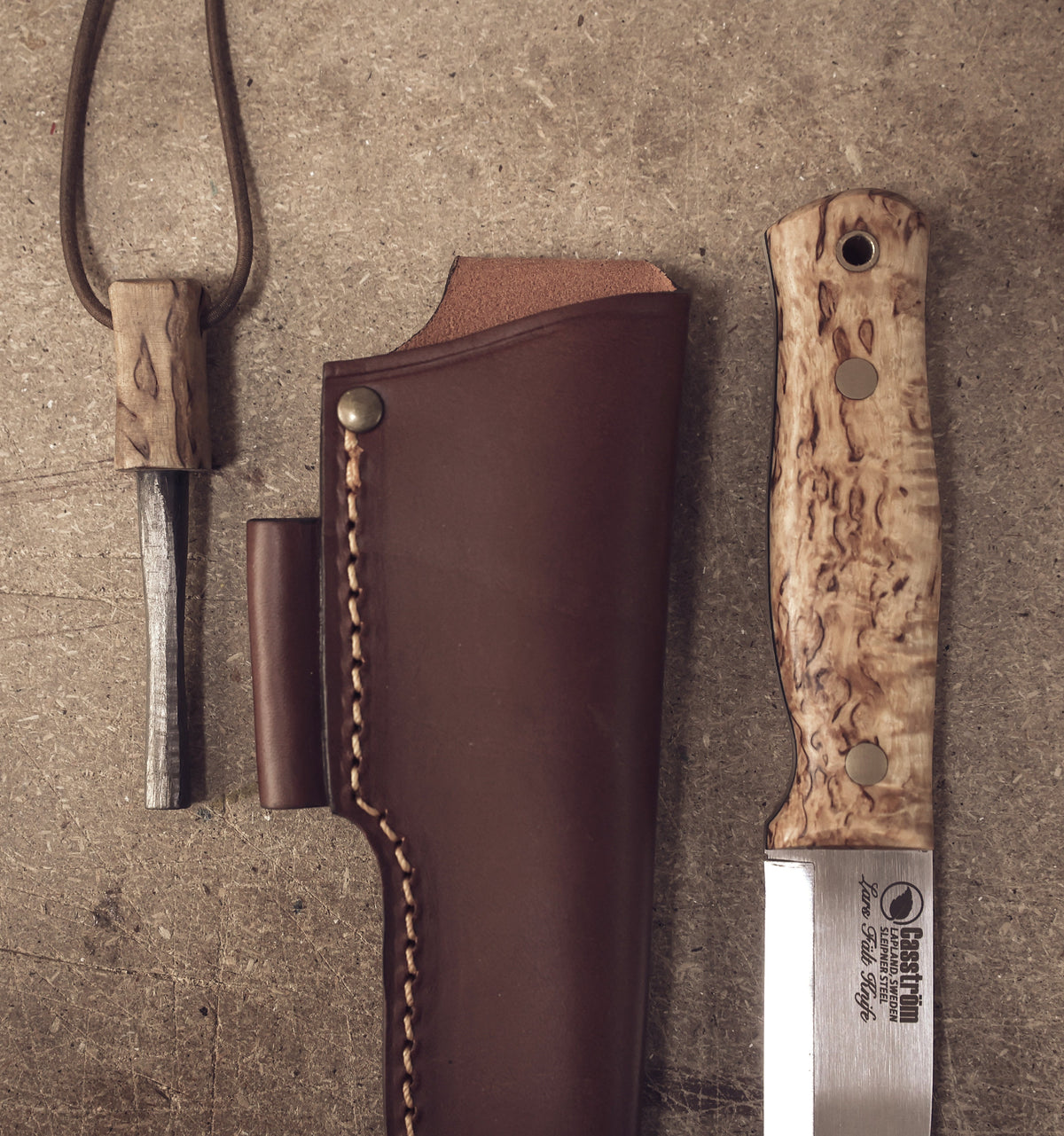
A knife that has prepared dozens of meals. A leather sheath that has darkened with use. A kuksa with memories of every camp.
We're constantly encouraged to move on to the next model. A bigger TV with more features. A better phone.
But what if we didn’t do that? What if we chose to buy less? Take better care of what we buy. Use it for years.
 Price Isn't the Same as Value
Now, you could argue that this is a marketing message in itself. And you'd be right to be sceptical. After all, Casström makes outdoor gear. But this isn't really about price. It's about value.
Some affordable tools are exceptionally good. Some expensive ones may not be right for you at all.
The question is not simply how much something costs.
It's whether it does the job you need it to do — and how long it can continue doing it.
A good piece of outdoor gear earns its place through usefulness. If you use it regularly, understand how it works and look after it properly, its value can extend far beyond the day you bought it.
Perhaps the better question is not:
"What's the cheapest option?"
But:
"What am I likely to still be using in five or ten years?"
Choose Things That Are Worth Keeping
I've bought expensive kit that hasn't worked for me, and I've bought cheap kit that has been a disaster.
One thing I do know is that when you're outdoors, you need to be able to trust your kit.
It doesn’t have to be the newest thing, or have a long list of features. It should be able to do the job you need it to do, and do that job for a long time.
I have woollen base layers from Woolpower that are close to fifteen years old. Still going strong. They were expensive at the time, but man, they have been a bargain over the years.
Keeping useful things in use for longer is a more responsible way to consume. The longer something remains useful, the less often it needs to be replaced.
But longevity is about more than reducing waste.
A tool or piece of clothing that stays with you gives you time to understand it. You learn how it performs. You discover its strengths and limitations. You learn how to get the best from it.
Over time, something that was once simply a purchase becomes familiar.
 Care for Your Kit — and Watch It Change
Natural materials will not look exactly the same forever, and this is one of the reasons I love natural materials.
The knife with patina. The darkened leather. The sweat-ringed cap. The soot-blackened coffee pot.
When my kit starts to change in appearance, it's a sign that I'm actually using it. That it's putting in the hours outside.
And in return, you owe that kit a bit of your time too. Look after it. Care for it. Over time, you develop a relationship with it.
There is something comforting about ageing kit. And it's not just a romantic idea that your gear tells the story of your adventures and travels. It's practical too.
You know what it can do, and that gives you confidence in the wilderness.
 Build Your Kit Over Time
I have made mistakes. I have been tempted to buy the odd “bargain” that turned out to be useless.
Zips, for instance, are a thing for me. I am obsessed with buying clothing with quality zips these days. You don’t get that obsession without first shedding a few tears!
I am reminded of a quote often attributed to John Ruskin. I have no idea whether he actually said it or not, but the wording has stuck with me:
“It is unwise to pay too much, but it is worse to pay too little. When you pay too much, you lose a little money—that is all. When you pay too little, you sometimes lose everything, because the thing you bought was incapable of doing the thing it was bought to do.”
Of course, there is absolutely no need to buy everything at once.
One of the pleasures is building your kit, until you get to the point where every item has earned its place in your pack.
Keep the things that work, and leave behind the things that don't. For me, that's part of the fun of every trip — paring down the kit until it is both efficient and personal.
A knife I trust. A kuksa I love. A pack that is comfortable.
Everything has to earn its place.
 Just right, not too much
There is a Scandinavian idea often associated with lagom: not too much, not too little, but enough.
I've always thought that's a pretty good way to approach outdoor gear.
You don't need every possible tool. And you don't necessarily need to replace something simply because it's looking a little frayed around the edges.
The more time you spend outdoors, the more you tend to learn what lagom looks like for you.
A simple and practical choice
I don't believe everyone needs the most expensive equipment. Nor do I believe there is one perfect choice for everyone.
Nowadays, I try to buy gear that suits the job I need it to do. I look after the things that need maintaining and repair things where practical. And if something still has plenty of life left, I keep using it.
Over time, this can change the relationship we have with the things we own.
The kettle I have at home is old and basic, but bombproof. There are kettles now that have sensors and touchscreens. Smart kettles - though why I would need my kettle to be smart is lost on me.
I love gadgets. I do.
But the kettle I have still works perfectly well. I need it to boil water, and that is precisely what it does.
So I'll keep using it.
Buy less. Choose well. Use it for years.
*************************
Leo Donkersley lives in southern Lapland and works for Casström. He is a passionate outdoorsman – though perhaps more a happy camper than a hardcore survivalist – and spends as much time as possible exploring the forest.