A sharp knife is a joy to use. But even a well-honed edge gradually loses some of its sharpness with use.
Stropping is a simple way to maintain and refine the edge between sharpenings.
A leather strop can help remove the small burr that remains after sharpening, refine the edge, and restore its sharpness and fine finish.
And once you get the hang of it, stropping only takes a few minutes.

What is stropping?
A strop is a piece of leather used to maintain and refine a knife edge.
Unlike a whetstone or a diamond sharpener, which are used to reshape or sharpen an edge, stropping is primarily a way to polish and maintain the edge.
The leather itself provides a mild abrasive effect, and stropping paste can enhance that effect.
After sharpening, a very small burr might remain along the edge. Stropping helps remove this burr and refine the edge, giving you a cleaner and sharper cutting surface.
That's why stropping can help you keep the edge sharp longer and reduce how often you need to do a more extensive sharpening.
When to strop a knife?
You don't have to wait until the knife is dull.
In fact, regular stropping is one of the easiest ways to keep your knife sharp.
If you strop your knife after use, you can help keep the sharp edge in good condition longer before it's time to bring out the whetstone or diamond sharpener.
It's particularly practical outdoors. A compact Field Strop can be carried in your gear and used when the edge starts to lose some of its sharpness.
If the edge is severely damaged, however, stropping is no substitute for sharpening. A heavily worn or damaged edge first needs to be sharpened with a more extensive method.

How to strop a knife
The technique is simple, but there's one rule to remember:
Always draw the knife away from the edge.
Place the edge against the leather and draw the knife towards its spine.
In other words: the spine goes first and the edge follows.
1. Place the knife against the leather
On a knife with a Scandi grind, the wide bevel provides a good reference. Place the bevel against the leather.
2. Draw the knife towards the spine
Using a smooth and controlled motion, draw the knife across the leather so that the edge follows.
Never push the edge forward into the leather.
3. Use light pressure
You don't need to press hard. Let the leather and abrasive do the work.
If you press too hard, the leather can be pushed up around the edge, which can counteract the precise edge you are trying to create.
4. Repeat on the other side
Flip the knife and repeat the same motion.
Casström recommends about 20 strokes per side as a starting point.
Over time, you'll learn how much stropping your particular knife needs.

Should you use stropping paste?
You can strop directly on the leather, but a stropping paste increases the abrasive effect.
Our polishing pastes are classified by relative abrasive action (Coarse / Medium / Fine) rather than by a specific grit value. Chromium oxide and aluminum oxide are supplied as fine powders with varying particle sizes. As the paste is used, the particles break down and polish, becoming gradually finer.
Therefore, an exact grit number would be misleading. The colour coding instead indicates how aggressive the paste is initially and where in the sharpening process it fits – not a fixed grit size.
Grey — Coarse
The coarse paste contains aluminum oxide and has the largest initial particle size.
It is used after a whetstone to restore the bite in the edge, remove burrs, and provide a rough pre-polish.
The paste gradually becomes finer as the particles break down, but it never becomes a high-gloss polishing paste.
White — Medium
The medium-coarse paste also contains aluminum oxide and has a larger initial particle size than the green paste.
This is the step between sharpening and polishing. It improves both sharpness and edge smoothness while polishing.
It's a good all-round option if you only want to use one paste.
If you're unsure which paste to start with, medium is an obvious choice.
Green — Fine
The fine paste contains chromium oxide and has a very small initial particle size.
It is intended for refining and polishing the edge to a glossy finish and is particularly suitable as a final step when you want a sharp, well-polished, and clean edge.
Do you need all three?
No.
You don't need to go through coarse, medium, and fine every time you strop.
If you are just maintaining an already sharp knife, medium or fine might be all you need.
If you are refining an edge after sharpening, or working with an edge that needs a bit more attention, you can start with the coarse paste and then move on to the finer steps.
View the three pastes as different tools for different stages in working with the edge, rather than as a routine that must always be followed from coarse to fine.
How much stropping paste should you use?
A little goes a long way.
Apply a small amount of paste to the leather and work it across the surface.
You don't need to apply a thick layer.
Over time, paste builds up on the strop. When there's too much, the excess can simply be scraped off – the spine of an old knife is a practical way to do this.
The goal is a suitable working layer of abrasive, not a thick coating.

Field Strop or Paddle Strop?
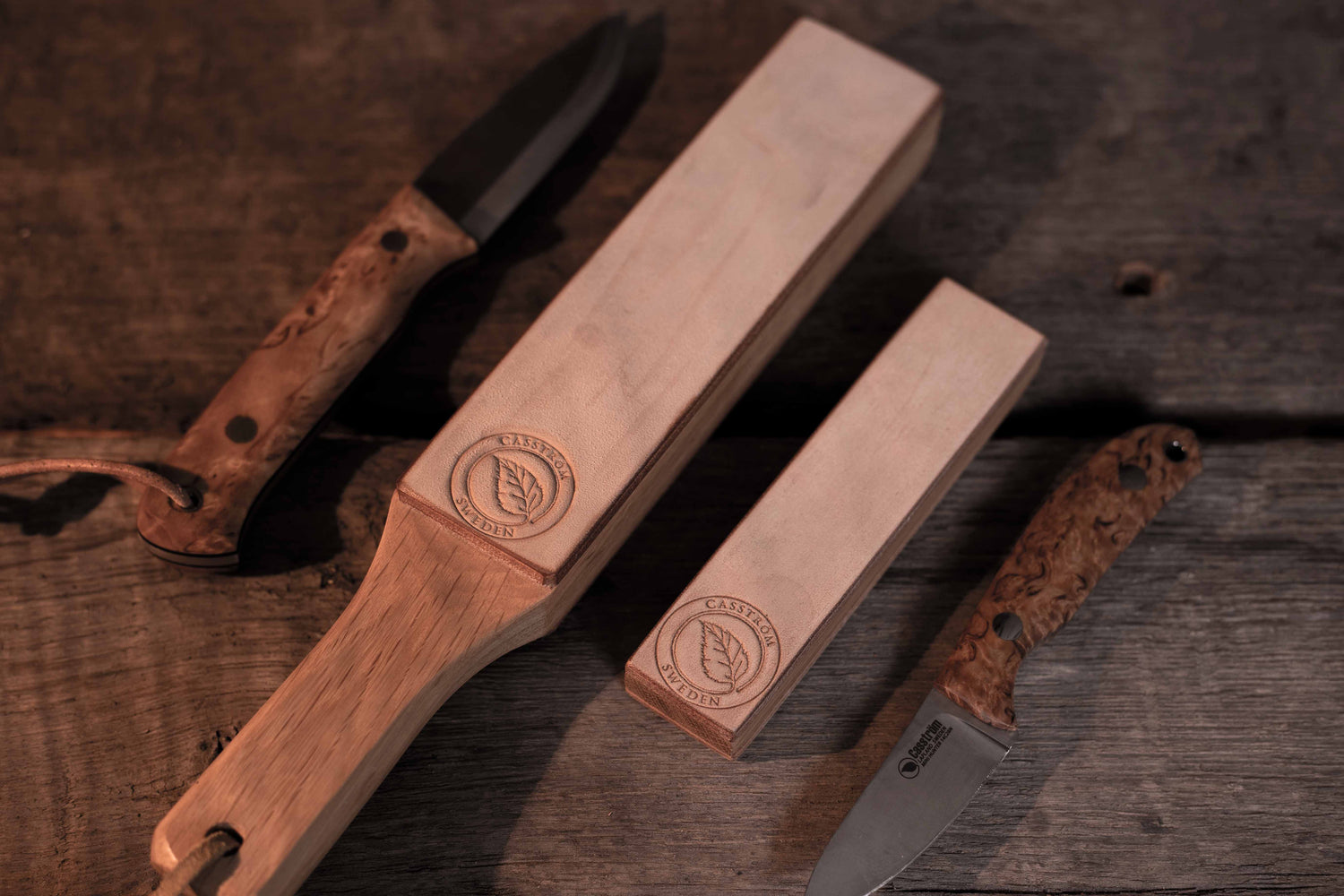
Casström has two leather strops suitable for slightly different situations.
Field Strop
The Field Strop is the compact option and is designed to fit easily in a pocket or pack.
Measuring 13 × 3 cm, it is particularly suitable for trips and other situations where space is limited and you want to be able to maintain your knife in the field.
It is handmade from approximately 3.5 mm vegetable-tanned Italian leather around a waxed core of European oak, with one coarse and one fine side.
Paddle Strop
The Paddle Strop has a larger working surface of 18 × 4.5 cm.
It is particularly well-suited for sharpening and knife maintenance at home or at base camp, where the larger surface makes it easier to work for longer periods.
Both are double-sided, with a coarser and a finer leather side.
Stropping a Scandi-ground knife
This deserves its own section because it is particularly relevant for Casström.
One of the advantages of a Scandi grind when stropping is that the wide bevel provides a clear reference for maintaining the correct angle.
Instead of trying to estimate a small secondary edge, you can use the existing bevel as a guide.
Place the bevel against the leather, keep it in contact with the surface, and draw the knife backward, spine first.
The same principle applies whether you are using a Field Strop out in the field or a Paddle Strop at home.
Common stropping mistakes
Pushing the edge into the leather
This is the most important thing to avoid.
Always draw the knife away from the edge.
Using too much pressure
Heavy pressure is not needed and can cause the leather to bulge up around the edge.
Use light and controlled pressure.
Using too much paste
More paste does not automatically mean better results.
Apply a small amount and replenish as needed.
Trying to repair a severely damaged edge
A strop is primarily a tool for maintenance and refining.
If the knife has chips, major damage, or a very dull edge, you should start with a proper sharpening.

A simple routine for knife maintenance
With regular outdoor use, knife maintenance doesn't have to be complicated.
Use the knife.
Strop the edge when it starts to lose some of its sharpness.
Sharpen it when stropping is no longer enough.
Finish with the strop.
Over time, stropping becomes less of a separate task and more a natural part of using and maintaining your knife.
And that's really the whole point.
A few minutes with a leather strop can help you keep a good knife in top condition.